Metal Roof Damage Deep Dive: Hail, Corrosion & Insurance
Standing seam metal roofs are built to last 50+ years — but hail, corrosion, and mechanical stress can compromise them in ways the naked eye won't catch. Here's what property owners and insurance professionals need to know.
Metal Roofing: A Brief Introduction
When considering a new roof or replacement, building owners increasingly turn to standing seam metal roofs. They offer better insulation, longer lifespan, and more durability than traditional roofing materials. Standing seam longevity is the biggest advantage — metal roofs last 50 years or more and carry longer warranties on metal roofing panels. They handle the toughest weather extremes, resist ice dams, and are incredibly energy efficient, making them an environmentally smart choice.
Threshold for Hail-Strike Damage
Damage to metal roof systems is defined as either functional damage or cosmetic damage. In a technical bulletin issued by the United States Steel Company, 'Hailstone Damage Characterized As Aesthetic Or Functional Damage', functional damage is defined as damage that diminishes the water-shedding capabilities and reduces the expected surface life of the roof.
- Rupture, cracks, or splits in the surface or protective coating
- Disengagement of lapped elements at the seam of metal roof panels
- Gap or disengagement of a fastener caused by hail impact
Hail-caused functional damage can occur in multiple ways. Courts have increasingly found that even cosmetic dents — those not visible from the ground — can constitute physical loss or damage for insurance purposes.
What the Courts Say: Cosmetic Dents Count
In Advanced Cable Co., LLC v. Cincinnati Insurance Co., a commercial building had hail dents that weren't visible from the ground. The court still ruled that the roof sustained physical damage and physical alteration — satisfying the 'physical loss or damage' requirement. The Seventh Circuit affirmed: 'denting changes the physical characteristics of the roof.' A Kansas federal court in Great Plains Ventures, Inc. v. Liberty Mutual Fire Insurance Co. reached the same conclusion: purely cosmetic hail dents that were not visible from the ground and did not affect functionality still 'physically alter an insured's property.' Several other courts have found that loss of merchantability can constitute physical loss or damage.
Static vs. Dynamic Dent Resistance
The study of dent resistance is divided into two main categories:
- Static denting — gradual loading from building expansion and contraction across seasons; governed by global stiffness of the panel
- Dynamic denting — higher-velocity impact from a hailstone or stone strike; deformation is more localized at the impact region
The effective dent resistance performance criterion for static loads is the residual displacement or deformation — the static dent depth. The 'oil canning load' is a critical factor: the point where localized panel curvature reverses, appearing as a transition from initial stiffness to secondary stiffness in the load-displacement curve.
Damages Due to Mechanical Stress (Abstract)
Researchers have studied the dent resistance of steel panels subjected to hail impact using finite element models (FEM). Artificial hailstones were launched at steel sheets at different terminal velocities to compare with natural hailstones that remained intact after impact.
- Dent depth is inversely proportional to panel thickness
- Dent diameter is proportional to yield stress
- As yield stress increases, dent depth decreases
- Not all hailstone sizes lead to visible denting in all thicknesses
Hailstorms pose significant risk to exposed building cladding materials — steel sheeting is the most important cladding material used in modern construction.
Stress & Galvanic Corrosion
The applied tensile stress from hail impact may induce microcracks in the passive oxide film of steel. Compressive stress can lead to debonding between the passive film and the substrate steel. Steel under both dynamic and static stresses corrodes faster than steel under compressive stress and no stress.
- Galvanic corrosion occurs between metals with different corrosion activities in the microstructure
- More active portions of the metal corrode while less active portions are galvanically protected
- Insoluble corrosion products (ICP) can have profound effects on corrosion kinetics
Passivation & Repassivation
All localized corrosion results from disruption of a protective film. This 'depassivation' process can result from stress applied to the steel or breakdown of the film by environmental interaction. Subsequent events that return the system to its former protective state are classified as 'repassivation.' In stress corrosion cracking, applied tensile stress not only increases the rate of breakdown events but also increases the rate of dislocation movement and bare metal production through slip step emergence — determining the rate of crack propagation.
Erosion Corrosion
Erosion applies to deterioration due to mechanical forces. When those forces accelerate the rate of corrosion, the attack is called erosion corrosion — usually caused by a corrodent, aqueous or gaseous, flowing over the metal surface.
- Attack takes the form of grooves, scooped-out rounded areas, horseshoe-shaped depressions, gullies, or waves
- Ultimate perforation due to thinning or progression of pits
- Rusting due to failure of the thinned panel to resist external fluid factors
All metal exposed to flowing fluid is subject to erosion corrosion, but damaged roofing systems are especially heavily affected.
Hydrogen Induced Cracking
Hydrogen phenomena are localized in nature. Atomic hydrogen — the smallest atom — is small enough to diffuse readily through a metallic structure. When the crystal lattice is saturated with atomic hydrogen, the mechanical properties of metals and alloys are diminished. Hydrogen sulfide (H2S) is the most commonly encountered species in this context.
- Hydrogen cracking results from combined factors of hydrogen and residual or applied tensile stresses
- Damage can result in cracking, embrittlement, loss of ductility, blistering, flaking, and micro perforation
- Molecular hydrogen formed in pores can cause disbondment of coatings
Stress Corrosion Cracking (SCC)
Stress Corrosion Cracking is defined as the growth of cracks due to the simultaneous action of a stress (nominally static and tensile) and a reactive environment. SCC does not exclude slow monotonic straining or low-amplitude cycling ('ripple loading'), which can accelerate SCC by promoting oxide film rupture at the crack tip.
- Cracks appear brittle with no deformation of adjacent metal, even if the mode of failure under stress alone is ductile
- Life decreases with increasing stress and is the sum of two parts
- Crack path may be intergranular or transgranular depending on metal type
Ferrous Metal Coating & Coloring
Standing seam metal roofs are available in pre-formed panels up to 100 feet long in a wide variety of materials, including pre-coated steel. The steel is coated in a continuous hot-dipped process with zinc, or zinc aluminum alloys such as zincalume and galvalume.
- Coils are finished with various paint systems including polyvinyl fluoride products such as Kynar 500 and Hylar 5000
- Polyvinylidene fluorides with at least 70% resin content are warranted to retain 85% of their original color for 20 years
- Lifetime warranty against chipping or peeling is standard for premium finishes
Cathodic Protection & Disbondment
Degradation of adhesion by cathodic protection (CP) is known as cathodic disbondment. Factors including pH, cathodic potential, the stability of the interfacial oxide, substrate surface roughness, defect geometry, coating formulations, cyclic wetting and drying, and water uptake all contribute. If CP completely penetrates the disbonded coating, the pH of the solution below the disbonded coating will be in the alkaline range — as high as 12 — causing coating disbondment and formation of crevices.
When a semipermeable membrane (e.g., Kynar coating) separates solutions of different concentrations, water permeates from the concentrated solution side to the dilute side — a process called osmosis. This facilitates the development of the osmosis process, which is electroosmosis when driven by cathodic protection current.
Conclusion: Why Metal Roof Claims Are Often Underpaid
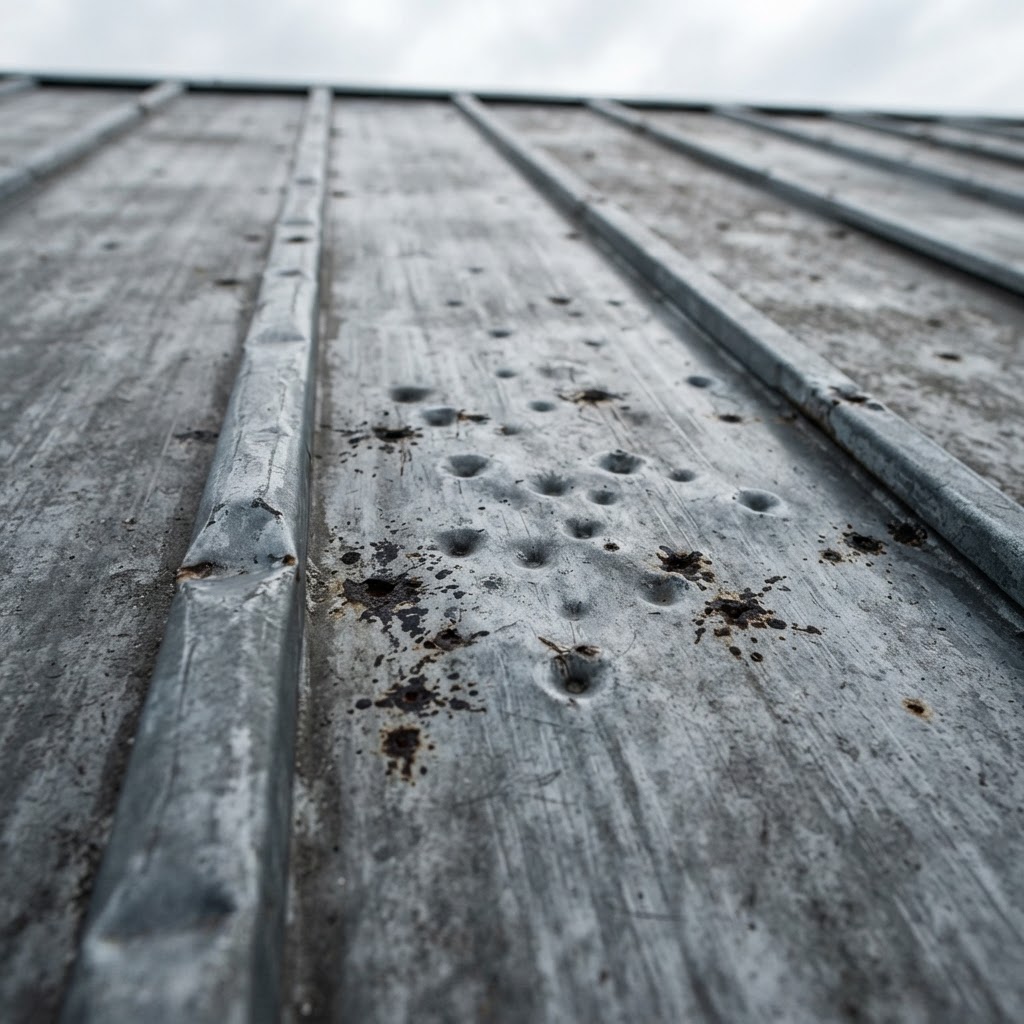
With homeowners' property being in the hardest-hit areas, oxidized spatter showing exactly where the hail hit and dent was left is present on a frame that affected this area. It's easy to assume such a roof would be approved — especially a metal roof over a back patio. Courts consistently confirm that cosmetic hail dents physically alter an insured's property. The molecular and microscopic level damage from hail impact — including corrosion initiation, stress concentrations, and coating failure — constitutes real, quantifiable property damage.
- Cosmetic dents trigger corrosion processes invisible to adjusters
- Coating damage from impact accelerates galvanic and erosion corrosion
- Legal precedent strongly supports coverage for metal roof hail damage
- Independent inspection with proper documentation is essential
If your metal roof has been hit by hail, don't accept a denial without a second opinion. Cox Roofing & Restoration specializes in metal roof inspections and insurance documentation across the St. Louis metro.
Ready for Your Free Inspection?
Cox Roofing & Restoration serves St. Louis, MO and surrounding communities.

